Comparing Shockwave Therapy Options: Why We Use Omniwave at Agudo Shockwave
Agudo Shockwave’s Physical Therapy-Led Approach to Radial vs. Focused Shockwave Therapy, Treatment Comfort, and Pain Relief
Written by Natalie Agudo, Founder & Patient Advocate, Agudo Shockwave · September 30, 2026
My Background in Physical Therapy
My background in physical therapy includes years of clinical experience in movement-based rehabilitation, chronic pain, pelvic health, dry needling, and hands-on treatment. I earned my Doctor of Physical Therapy degree, and my experience working with complex and persistent pain taught me to look beyond simply identifying where someone hurts.
That clinical background ultimately shaped my interest in shockwave technology and why I chose Omniwave when developing Agudo Shockwave. Today, my role at Agudo Shockwave is Founder and Patient Advocate. Clinical physical therapy services are provided by our licensed physical therapists.
How I Discovered Shockwave Therapy
When I first learned about shockwave therapy, it wasn’t from a sales rep or a conference. It was from my own family.
Some of my relatives had received shockwave therapy in Korea and shared their experiences with me. I was immediately curious. At that point in my clinical career, I was already working heavily with chronic pain, dry needling, and movement-based rehabilitation. I was used to treating stubborn pain problems that hadn’t responded well to basic rest, stretching, massage, injections, or medication.
My background as a dry needling specialist especially shaped my interest. Dry needling allowed me to create a targeted stimulus in tissues that could be difficult to reach from the outside—but needles aren’t easy for everyone. I started wondering whether there was another way to stimulate tissue healing without using a needle.
Shockwave therapy fascinated me because it offered a non-invasive way to create a mechanical stimulus in tissue using acoustic wave energy. Research suggests this stimulus may influence biological processes related to blood flow, tissue remodeling, and pain modulation (Moya et al., 2018; Notarnicola & Moretti, 2012).
My First Experience With Radial Shockwave
In 2024, I started using a radial wave machine with a business partner. That was my first hands-on experience providing this type of treatment, and I saw patients with chronic pain and stubborn soft tissue problems respond in ways that caught my attention. Dry needling allowed me to target very specific points, while radial wave gave me a way to work more comprehensively across a larger area.
But I noticed something else: radial wave could be uncomfortable—sometimes very uncomfortable. I was even being taught to use lidocaine cream to help people tolerate treatment, and that made me pause.
I have never believed a treatment has to be brutally painful to be effective.
There is a difference between providing a meaningful therapeutic stimulus and making someone feel like they have to white-knuckle their way through care. That distinction matters even more with chronic pain, where the nervous system, previous experiences, expectations, stress, and tissue input can all influence the pain experience (Moseley & Butler, 2015).
I wanted a treatment experience that was purposeful without making pain tolerance the goal. So I kept researching.
Radial vs. Focused Shockwave Therapy: What’s the Difference?
I went to professional conferences, tried different machines, talked to shockwave companies, received treatments at local clinics, and started looking much more closely at the technology itself. That process taught me something important: “shockwave therapy” is not one single thing.
Two major categories patients may hear about are radial pressure wave and focused shockwave. Radial pressure wave is generally created through a ballistic or pneumatic mechanism. The resulting pressure waves spread outward into the tissue, with the strongest energy typically closer to the surface and decreasing as it travels deeper.
Focused shockwave is designed differently. It concentrates acoustic energy toward a specific target zone at depth. That distinction caught my attention because throughout my clinical career, I had worked with problems involving deeper muscles, tendons, joints, and other structures that aren’t necessarily easy to influence from the surface.
Radial wave gave me a way to work broadly, while focused shockwave gave me a way to think more specifically about depth.
That doesn’t mean focused shockwave is always better. Research includes different technologies, energy levels, conditions, treatment depths, and protocols, making direct comparisons difficult (Moya et al., 2018; Speed, 2014). But understanding those differences became an important part of choosing the technology I wanted for Agudo Shockwave.
Why I Chose Omniwave
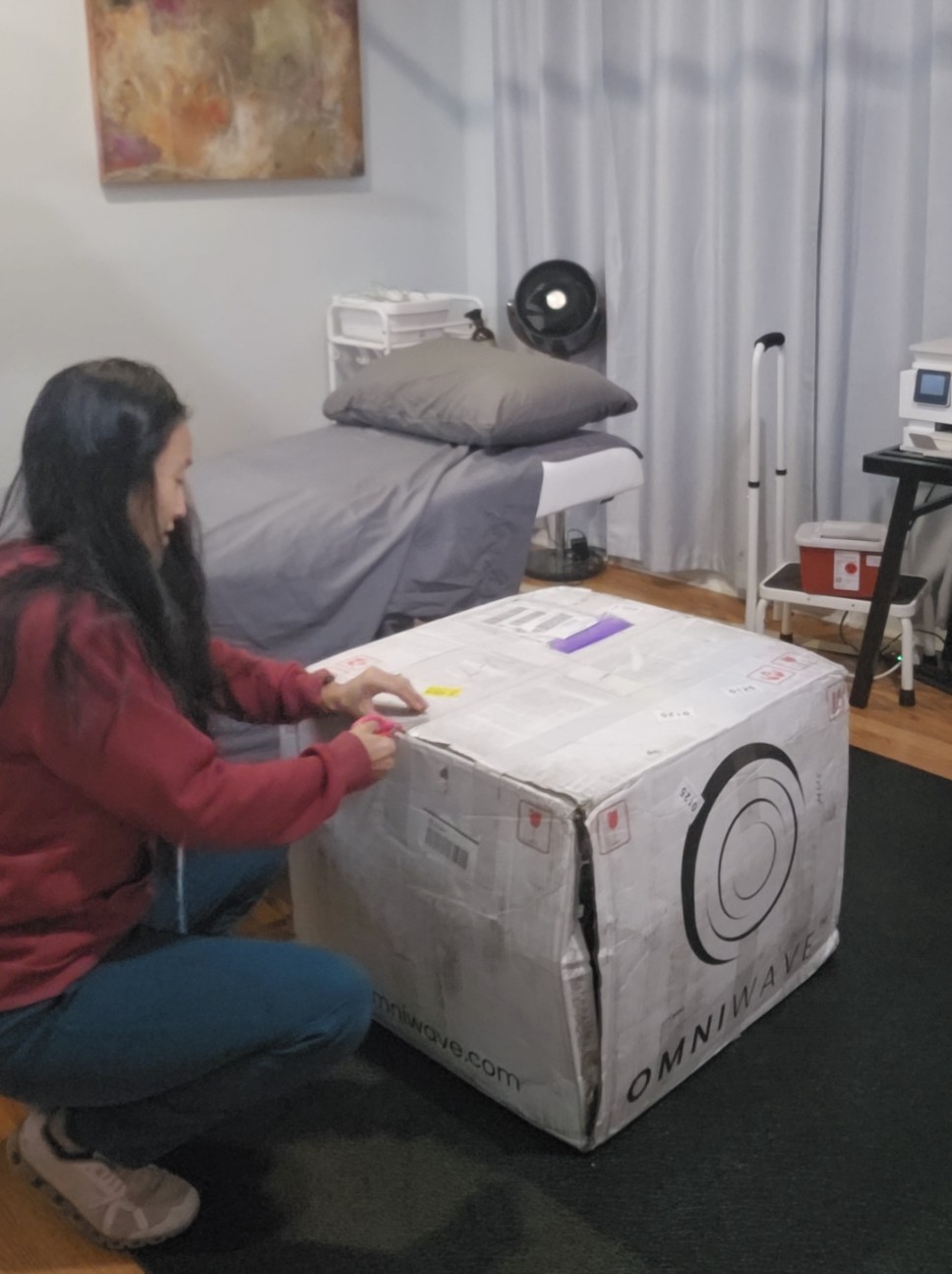
As I continued researching, I learned that even focused shockwave isn’t one single technology. Focused shockwaves can be generated through electromagnetic, piezoelectric, or electrohydraulic systems.
Omniwave uses electrohydraulic focused shockwave technology, which generates a pressure wave through a spark discharge in fluid and focuses that energy toward the treatment area. I wasn’t drawn to Omniwave simply because it sounded more advanced. I was interested because the technology aligned with what mattered to me clinically: depth, precision, and the patient experience.
It was also a significant investment. The radial machine I initially worked with already cost about the equivalent of one of my cars. Omniwave was closer to the equivalent of three, so I did not take the decision lightly.
Ultimately, Omniwave stood out because it brought together three things I was looking for: focused energy, depth control, and a more comfortable treatment experience.
I wanted technology capable of reaching deeper tissues without relying only on needles. I wanted something more comprehensive than pinpoint dry needling but more specific than surface-level soft tissue work. And I wanted people dealing with chronic pain to have a treatment experience that didn’t revolve around seeing how much discomfort they could tolerate.
Omniwave fit that philosophy. It isn’t painless for every person, and it isn’t magic. But it offered the combination of depth, precision, and patient experience I had been looking for.
What About Joint Pain and Arthritis?
Another reason focused shockwave interested me was the developing research around joint pain and osteoarthritis. Arthritis is more complicated than simply “wear and tear.” Pain can involve bone, cartilage, inflammation, joint sensitivity, muscle guarding, movement changes, and the nervous system.
Shockwave therapy is not a cure for arthritis, and we don’t present it that way. However, research suggests extracorporeal shockwave therapy may help reduce pain and improve function in some people with knee osteoarthritis, while researchers continue investigating its effects on tissue biology and pain (Wang et al., 2017; Zhao et al., 2013).
The research is still evolving, and not everyone with arthritis needs focused shockwave. But if Agudo Shockwave was going to work with deeper joint and musculoskeletal problems, I wanted our licensed physical therapists to have technology capable of directing energy toward deeper tissues in a controlled way.
Agudo Shockwave’s Physical Therapy-Led Approach
Agudo Shockwave was never intended to be a business built around a machine alone. Our physical therapy-led approach means clinical care is provided by licensed physical therapists who can consider the bigger picture—not simply where someone hurts.
That may include how you move, what activities increase your symptoms, what you’ve already tried, your goals, how your tissues respond to load, and what may help support progress outside of treatment. Stubborn pain is rarely just about one painful spot.
The technology matters, but the plan matters too.
I chose Omniwave because I wanted Agudo Shockwave to offer more than a generic shockwave experience. I wanted advanced technology to exist alongside thoughtful clinical care.
Because shockwave research continues to evolve, we also aren’t interested in making exaggerated promises. Our team continues to follow the research, while our licensed physical therapists use clinical reasoning and patient response to determine whether—and how—shockwave belongs in someone’s plan of care.
Shockwave can be a powerful tool, but it shouldn’t replace clinical reasoning. It should support it.
Want to Learn More?
Not sure where to start? Schedule a Discovery Call with Agudo Shockwave to learn more about our services, ask questions, and understand your options.
Ready to work with one of our licensed physical therapists? Book an Omniwave Strategy Session for a clinical evaluation and to determine whether focused shockwave therapy may be appropriate for you.
References
- Moseley, G. L., & Butler, D. S. (2015). Fifteen years of explaining pain: The past, present, and future. The Journal of Pain, 16(9), 807–813.
- Moya, D., Ramón, S., Schaden, W., Wang, C. J., Guiloff, L., & Cheng, J. H. (2018). The role of extracorporeal shockwave treatment in musculoskeletal disorders. The Journal of Bone and Joint Surgery. American Volume, 100(3), 251–263.
- Notarnicola, A., & Moretti, B. (2012). The biological effects of extracorporeal shock wave therapy in musculoskeletal regenerative medicine. Journal of Biological Regulators and Homeostatic Agents, 26(2), 219–228.
- Speed, C. (2014). A systematic review of shockwave therapies in soft tissue conditions: Focusing on the evidence. British Journal of Sports Medicine, 48(21), 1538–1542.
- Wang, C. J., Cheng, J. H., Chou, W. Y., Hsu, S. L., Chen, J. H., & Huang, C. Y. (2017). Changes of articular cartilage and subchondral bone after extracorporeal shockwave therapy in osteoarthritis of the knee. International Journal of Medical Sciences, 14(3), 213–223.
- Zhao, Z., Jing, R., Shi, Z., Zhao, B., Ai, Q., & Xing, G. (2013). Efficacy of extracorporeal shockwave therapy for knee osteoarthritis: A randomized controlled trial. The Journal of Surgical Research, 185(2), 661–666.