Not All Shoulder Pain Is the Same: How Shockwave Therapy Fits Your Shoulder
Rest, a cortisone shot, and stretches from social media haven't fixed it. Here's what does.
Written by Agudo Shockwave Team · Clinically reviewed by Evan Cowen, PT, DPT · October 14, 2026
If your shoulder has hurt for months, or years, you've probably already done the sensible things. Rested it. Iced it. Stretched. Tried a few exercises you found on social media. Maybe had a cortisone shot.
And it still hurts reaching overhead, putting on a jacket, or rolling onto it at night.
That's because rest, cortisone, and exercise all treated your shoulder as one sore spot, and it isn't. There's a tendon that needs to heal, and there's a system around it (shoulder blade, upper back, neck) that needs to stop overloading it. Those are two different jobs. Shockwave does the first. Physical therapy does the second. At Agudo Shockwave, you get both in one plan.
Why your shoulder is still hurting
The shoulder isn't one joint, it's four working together: the ball-and-socket joint where the arm meets the shoulder blade, the joint where the collarbone meets the shoulder blade, the joint where the collarbone meets the breastbone, and the gliding surface where the shoulder blade rides on the rib cage. Every overhead reach depends on all four moving in a coordinated rhythm (Kibler et al., 2013). When one of them is stiff, unstable, or moving out of sequence, the others compensate, and the rotator cuff tendons often end up absorbing the extra load.
That's not the whole picture either. The shoulder blade sits on the rib cage, so a rounded upper back changes where the socket points before the arm even moves. The nerves that run to the arm pass through the neck and under the collarbone, so neck stiffness or nerve irritation can produce pain that feels like it's coming from the shoulder. And how your neck and upper back are positioned all day changes how much the rotator cuff has to work on every lift.
So persistent shoulder pain usually has two layers. The irritated tissue, often a rotator cuff tendon, is one layer. The reason that tissue became overloaded is the other. Tendons get stronger when they're loaded the right amount and break down when they're asked for more than they can currently handle; researchers describe this as a continuum where adding or removing load moves a tendon toward pathology or back toward health (Cook & Purdam, 2009). Lasting relief means treating the tissue and fixing what overloaded it.
Why what you've tried hasn't closed the gap
Rest quiets the shoulder without rebuilding it. Unloading a tendon causes cell and tissue changes similar to those seen in an overloaded one, and it lowers the tendon's mechanical integrity (Cook & Purdam, 2009). So rest feels better, then reaching overhead flares it, then you rest again. That cycle can run for years.
Cortisone buys time, not capacity. In the largest trial of its kind, a steroid injection improved shoulder pain and function at eight weeks, but the advantage was gone by six months (Hopewell et al., 2021). The shot calms the tissue. It doesn't change what the tissue can do, and it doesn't touch the reason it was overloaded.
Generic exercises miss on dose or type. Strengthening the shoulder is the right idea. The problem is that how much to load, how often, and which kind of exercise all matter more than most people expect. Shoulder experts are frank that even figuring out which tissue is causing the pain is harder than it looks, which is why good shoulder care tests whether changing how you move changes your symptoms, rather than guessing from an image or a label (Lewis, 2016). Exercises chosen without that step are unlikely to get there.
Treating only the painful spot misses the drivers. If the shoulder blade isn't rotating properly, the upper back is stiff, or the neck is contributing, working the sore tendon by itself treats the symptom and leaves the cause alone. The pain comes back because the underlying issue that caused it never changed.
How we treat it: two tools, one plan
Step 1: Find the reasons for pain
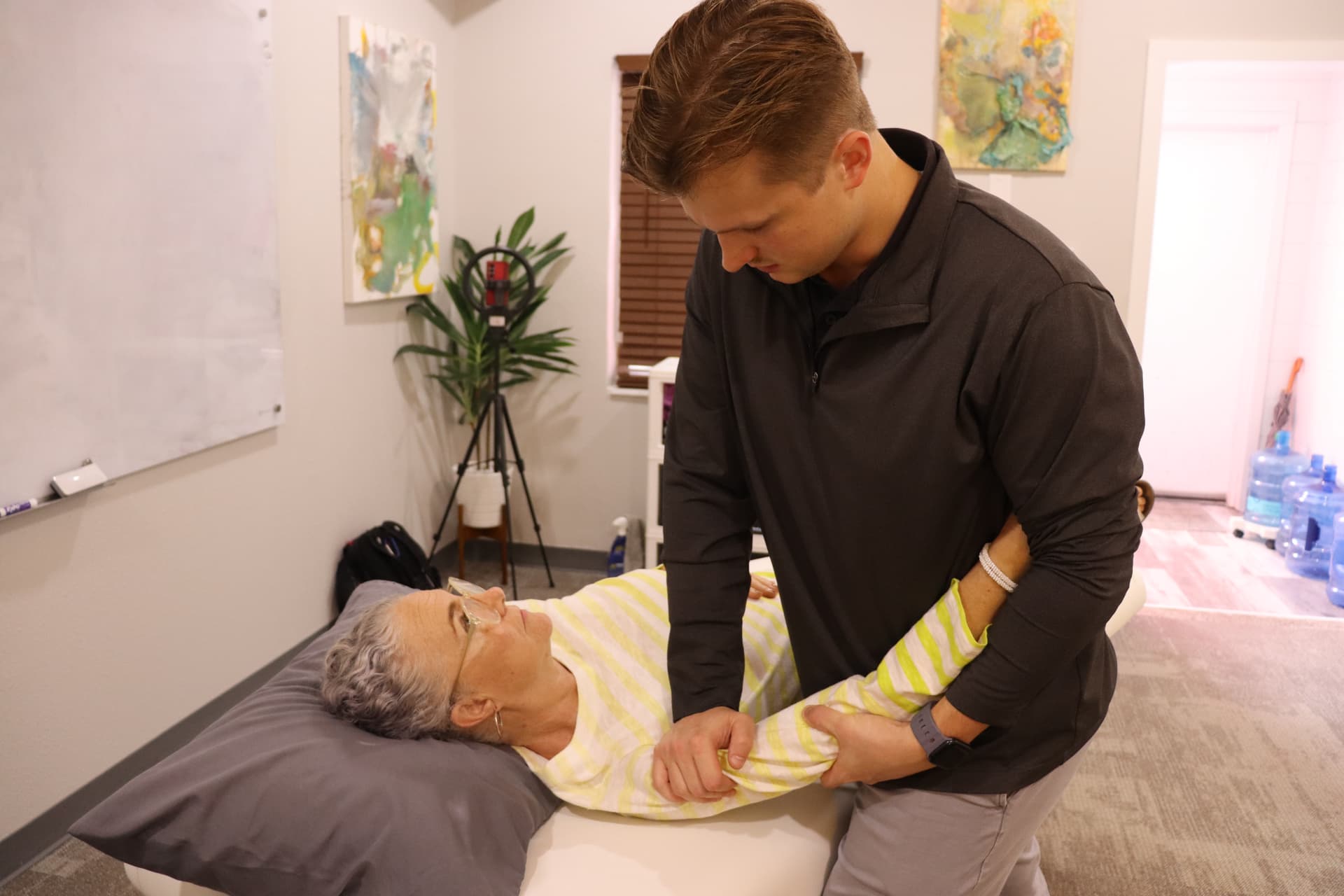
Every patient starts with an Omniwave Strategy Session, a clinical evaluation with a licensed physical therapist. This isn't simply a formality before treatment- it creates the treatment plan.
We look at where the pain actually is and what reliably brings it on. We test how much load your shoulder tolerates right now. We check each of the four shoulder joints for stiffness, control, and how they move in sequence. We assess the neck and upper back, both for posture and for whether they're producing or contributing to the pain. We screen the nerves running to the arm. We check rotator cuff and shoulder blade strength on both sides. We watch you reach, lift, and press, and we see whether changing how you move changes the pain. We ask what you've tried and how it's progressed.
Shoulder pain is a descriptor, not a diagnosis. Rotator cuff tendon pain, a calcium deposit in a tendon, a frozen shoulder, a stiff collarbone joint, and pain referred from the neck all behave differently and need different plans. The assessment tells us which situation you're in, and that determines what physical therapy focuses on and where shockwave is applied.
Step 2: Physical therapy retrains the system
We're not just strengthening muscles. We're retraining how they fire, how the four shoulder joints move together, and how well the whole system controls the shoulder while you move.
A shoulder blade that doesn't rotate or tilt properly, or a rotator cuff that fires late, lets the ball ride up or forward in the socket and overloads the tendons. A stiff upper back forces the shoulder to make up range it shouldn't have to. Retraining that control, restoring motion where it's missing, and building strength on top of it is how we change the load your shoulder sees on every reach. This is why a well-constructed, progressive exercise approach produces outcomes at least as good as surgery for rotator cuff related shoulder pain (Lewis, 2016).
The loading itself is progressive. We start where your shoulder can tolerate and build in stages, rather than pushing through pain and hoping.
Step 3: Shockwave changes the tissue
Shockwave delivers acoustic (sound-wave) energy into the irritated tissue. It makes a difference in three ways that matter for a stuck shoulder:
It begins a healing response. Shockwave at lower energy settings may help initiate the tendon healing process and support tissue regeneration (Chen et al., 2022; largely from animal and lab studies). The proposed mechanism is mechanotransduction: cells convert the mechanical stimulus into a biochemical signal, releasing growth factors and promoting new blood vessel growth in tissue that has been stagnant. For a tendon that has stopped adapting on its own, this is a nudge to start again. It's generally reserved for tendons that haven't responded to other conservative care, and may be best suited to longer-standing tendon problems (Chen et al., 2022).
It can break up calcium. When a calcium deposit has formed inside a rotator cuff tendon, shockwave does something no exercise can: it helps dissolve the deposit itself. This is the shoulder condition where shockwave has the strongest evidence, and we come back to it below.
It modulates pain. Shockwave appears to reduce pain through several routes, including hyperstimulation of the painful area, which dampens the pain signal reaching the brain, and effects on the small nerve fibers involved in pain (Chen et al., 2022). A shoulder that hurts less can be loaded more, and that's where the two treatments start working together.
Why we do both: Shockwave works on the tissue. Physical therapy works on the load and the control. Those are different problems, and the longer a shoulder has hurt, the more likely it has both. Shockwave helps the tendon respond and opens a window where loading is tolerable; physical therapy uses that window to build capacity and fixes the movement problem that overloaded the tendon in the first place, so the gains hold after the sessions end. A review of combined shockwave and exercise found the pairing produced positive results across tendinopathies, outperforming either alone (Burton, 2022).
Step 4: Progress the load, taper the shockwave
Shockwave is mostly performed in the short-term, but it’s effects are long lasting. To reinforce progress made, it’s important that the loading program continues beyond use of the machine, because the strength and control you build is what keeps the shoulder working after treatment ends. We adjust the plan as your shoulder responds. Your physical therapist decides when to add load, when to hold, and when shockwave has done its job.
Which shoulder problem you have changes the plan
Most persistent shoulder pain involves the rotator cuff, but it isn't the only tissue shockwave treats, and even "rotator cuff pain" splits into two conditions that need different plans. Here's how the assessment sorts them, and what each one means for treatment.
Calcific tendinitis. A calcium deposit forms inside the tendon, most often at the top of the shoulder, and tends to flare suddenly, often at night, when the body starts breaking it down (Uhthoff & Loehr, 1997). The deposit is the problem, and shockwave attacks it directly: a review of 28 randomized trials found high-energy shockwave consistently beat placebo for pain, function, and dissolving the deposit, and a landmark JAMA trial found high-energy superior to low (Bannuru et al., 2014; Gerdesmeyer et al., 2003). The energy setting is your physical therapist's call, not a preset, and physical therapy runs alongside to restore the motion that months of guarding have cost.
Non-calcific rotator cuff pain. The far more common version: no deposit, just a tendon asked for more than it can handle for too long, with risk rising sharply after 50 and with overhead work or sport (Leong et al., 2019). The problem here is capacity and how the whole shoulder complex loads the tendon, so physical therapy leads, and shockwave's job is to help a stagnant tendon respond to loading while keeping pain low enough to progress. The evidence for shockwave alone is more mixed here than for calcific tendinitis (Surace et al., 2020), which fits: a tissue treatment can't fix a load problem by itself.
Biceps tendinopathy. The long head of the biceps runs through the front of the shoulder and is a common source of front-of-shoulder pain that gets mistaken for, or coexists with, rotator cuff pain. A 2026 trial of 144 adults found that adding shockwave to a rehabilitation program improved function and reduced pain compared with sham shockwave plus the same program (Ma et al., 2026).
Frozen shoulder. A meta-analysis of 20 randomized trials found that adding shockwave to standard treatment improved pain and function in the short term, with less certain long-term results (R. Zhang et al., 2022). Frozen shoulder is a stiffness problem as much as a pain problem, so shockwave supports a mobility program rather than replacing it.
Subacromial pain and impingement. Pain under the acromion of the shoulder with overhead reach, often not traceable to a single tendon. In a randomized trial, shockwave plus rotator cuff strengthening beat shockwave alone for pain, function, and muscle endurance at two months (Santamato et al., 2016). Shockwave by itself isn't the answer here; shockwave plus the right loading is.
Where shockwave fits
Shockwave is a tool for the tissue, wherever that tissue is. It won't change how your shoulder blade moves, restore range in a frozen shoulder on its own, or fix a shoulder that's being asked for too much, too fast. That's why blending shockwave with physical therapy can work so well.
But here's where our approach differs from most clinics offering shockwave. If the assessment shows the driver isn't the shoulder at all, but that the pain is coming from the neck or that upper back, we don't treat the shoulder directly and hope. We treat the neck. There's a solid basis for doing so: a meta-analysis of 10 randomized trials found that shockwave significantly reduced pain in myofascial pain of the trapezius, the muscle running from the neck to the shoulder blade that so often harbors the trigger points behind neck-and-shoulder pain (Q. Zhang et al., 2020). Shockwave goes where the problem is, and the physical therapist is the one who finds it. Treating only the spot that hurts is how shoulder pain drags on for months and turns into years.
The physical therapist decides the plan. Not a protocol, and not the device.
The bottom line
Shoulder pain that has lasted months or years means there's a gap between what your shoulder is asked to do and what it can handle, and because the shoulder is four joints plus a neck and upper back, the reason for that gap is rarely in the sore spot alone. Rest doesn't close it. Cortisone closes it for a few weeks. Generic exercises often miss the dose, the type, or the driver. At Agudo Shockwave, a physical therapist finds the driver, physical therapy retrains and reloads the system, and shockwave treats the tissue wherever that driver is, so the loading can do its work. Two effective treatments, built into one plan for your shoulder.
Want to learn more?
Not sure where to start? Schedule a Discovery Call with Agudo Shockwave to ask questions and understand your options.
Ready for a clinical evaluation? Book an Omniwave Strategy Session with one of our licensed physical therapists to find out what's driving your shoulder pain and how shockwave fits your plan.
References
- Bannuru, R. R., Flavin, N. E., Vaysbrot, E., Harvey, W., & McAlindon, T. (2014). High-energy extracorporeal shock-wave therapy for treating chronic calcific tendinitis of the shoulder: A systematic review. Annals of Internal Medicine, 160(8), 542–549. https://doi.org/10.7326/M13-1982
- Burton, I. (2022). Combined extracorporeal shockwave therapy and exercise for the treatment of tendinopathy: A narrative review. Sports Medicine and Health Science, 4(1), 8–17. https://doi.org/10.1016/j.smhs.2021.11.002
- Chen, Y., Lyu, K., Lu, J., Jiang, L., Zhu, B., Liu, X., Li, Y., Liu, X., Long, L., Wang, X., Xu, H., Wang, D., & Li, S. (2022). Biological response of extracorporeal shock wave therapy to tendinopathy in vivo (review). Frontiers in Veterinary Science, 9, 851894. https://doi.org/10.3389/fvets.2022.851894
- Cook, J. L., & Purdam, C. R. (2009). Is tendon pathology a continuum? A pathology model to explain the clinical presentation of load-induced tendinopathy. British Journal of Sports Medicine, 43(6), 409–416. https://doi.org/10.1136/bjsm.2008.051193
- Gerdesmeyer, L., Wagenpfeil, S., Haake, M., Maier, M., Loew, M., Wörtler, K., Lampe, R., Seil, R., Handle, G., Gassel, S., & Rompe, J. D. (2003). Extracorporeal shock wave therapy for the treatment of chronic calcifying tendonitis of the rotator cuff: A randomized controlled trial. JAMA, 290(19), 2573–2580. https://doi.org/10.1001/jama.290.19.2573
- Hopewell, S., Keene, D. J., Marian, I. R., Dritsaki, M., Heine, P., Cureton, L., Dutton, S. J., Dakin, H., Carr, A., Hamilton, W., Hansen, Z., Jaggi, A., Littlewood, C., Barker, K. L., Gray, A., & Lamb, S. E. (2021). Progressive exercise compared with best practice advice, with or without corticosteroid injection, for the treatment of patients with rotator cuff disorders (GRASP): A multicentre, pragmatic, 2 × 2 factorial, randomised controlled trial. The Lancet, 398(10298), 416–428. https://doi.org/10.1016/S0140-6736(21)00846-1
- Kibler, W. B., Ludewig, P. M., McClure, P. W., Michener, L. A., Bak, K., & Sciascia, A. D. (2013). Clinical implications of scapular dyskinesis in shoulder injury: The 2013 consensus statement from the "Scapular Summit." British Journal of Sports Medicine, 47(14), 877–885. https://doi.org/10.1136/bjsports-2013-092425
- Leong, H. T., Fu, S. C., He, X., Oh, J. H., Yamamoto, N., & Yung, S. H. P. (2019). Risk factors for rotator cuff tendinopathy: A systematic review and meta-analysis. Journal of Rehabilitation Medicine, 51(9), 627–637. https://doi.org/10.2340/16501977-2598
- Lewis, J. (2016). Rotator cuff related shoulder pain: Assessment, management and uncertainties. Manual Therapy, 23, 57–68. https://doi.org/10.1016/j.math.2016.03.009
- Ma, Z., et al. (2026). Effect of extracorporeal shock wave therapy combined with Kinesio taping on shoulder function in patients with long-head biceps tendinopathy: A randomized controlled trial. Archives of Physical Medicine and Rehabilitation. Advance online publication. https://doi.org/10.1016/j.apmr.2026.03.007
- Santamato, A., Panza, F., Notarnicola, A., Cassatella, G., Fortunato, F., de Sanctis, J. L., Valeno, G., Filoni, S., Baldassarre, A., Ranieri, M., & Fiore, P. (2016). Is extracorporeal shockwave therapy combined with isokinetic exercise more effective than extracorporeal shockwave therapy alone for subacromial impingement syndrome? A randomized clinical trial. Journal of Orthopaedic & Sports Physical Therapy, 46(9), 714–723. https://doi.org/10.2519/jospt.2016.4629
- Surace, S. J., Deitch, J., Johnston, R. V., & Buchbinder, R. (2020). Shock wave therapy for rotator cuff disease with or without calcification. Cochrane Database of Systematic Reviews, 2020(3), CD008962. https://doi.org/10.1002/14651858.CD008962.pub2
- Uhthoff, H. K., & Loehr, J. W. (1997). Calcific tendinopathy of the rotator cuff: Pathogenesis, diagnosis, and management. Journal of the American Academy of Orthopaedic Surgeons, 5(4), 183–191. https://doi.org/10.5435/00124635-199707000-00001
- Zhang, Q., Fu, C., Huang, L., Xiong, F., Peng, L., Liang, Z., Chen, L., He, C., & Wei, Q. (2020). Efficacy of extracorporeal shockwave therapy on pain and function in myofascial pain syndrome of the trapezius: A systematic review and meta-analysis. Archives of Physical Medicine and Rehabilitation, 101(8), 1437–1446. https://doi.org/10.1016/j.apmr.2020.02.013
- Zhang, R., Wang, Z., Liu, R., Zhang, N., Guo, J., & Huang, Y. (2022). Extracorporeal shockwave therapy as an adjunctive therapy for frozen shoulder: A systematic review and meta-analysis. Orthopaedic Journal of Sports Medicine, 10(2), 23259671211062222. https://doi.org/10.1177/23259671211062222