Knee Pain That Won't Go Away? Shockwave Therapy + Physical Therapy Explained
Why your knee is still hurting, and the two-part approach we use at Agudo Shockwave.
Written by Agudo Shockwave Team · Clinically reviewed by Evan Cowen, PT, DPT · October 9, 2026
If your knee has hurt for months, you've probably already done the sensible things. Rested it. Iced it. Stretched. Tried a few exercises you found on social media. Maybe a brace.
And it still hurts on stairs, getting out of a chair, or ten minutes into a run.
This post explains why that happens, and how we treat it at Agudo Shockwave. Our approach pairs two things: neuromuscular physical therapy, which retrains how your hip and knee work together under load, and shockwave therapy, which changes what's happening inside the irritated tissue. Each one does something the other can't. Here's how they fit.
Why your knee is still hurting
Your knee is built to handle load. The tendons, cartilage, and muscles around it get stronger when they're loaded the right amount, and they break down when they're asked for more than they can currently handle. Tendon researchers describe this as a continuum: adding or removing load is what moves a tendon toward pathology or back toward health (Cook & Purdam, 2009).
Persistent knee pain almost always comes down to a gap between what your knee is being asked to do and what it can currently tolerate. Everything we do is aimed at closing that gap from the right side: not by asking less of the knee forever, but by rebuilding what it can handle.
Why what you've tried hasn't closed the gap
Rest quiets the knee without rebuilding it. Unloading a tendon causes cell and tissue changes similar to those seen in an overloaded one, and it lowers the tendon's mechanical integrity (Cook & Purdam, 2009). So rest feels better, then activity flares it, then you rest again. The knee feels better with rest, but doesn’t get stronger.
Generic exercises miss on dose or type. Strengthening the knee is the right idea. The problem is that how much to load, how often, and which kind of exercise all matter more than most people expect. In a head-to-head trial, the exact same knee problem responded differently depending on how the loading was built (Breda et al., 2021). Even specialists admit that getting the dose right is hard (Collins et al., 2018). If it's hard for them with a plan built for one knee, exercises chosen without an assessment of yours are unlikely to get there.
Treating only the knee misses potential underlying factors. The knee is the bridge between the hip and the ankle. The same consensus recommends exercise targeting both the hip and the knee for every patient with patellofemoral pain (Collins et al., 2018). A plan that only works the knee is often working on the symptom, while possibly ignoring the underlying cause.
How we treat it: two tools, one plan
Step 1: Find the reasons for pain
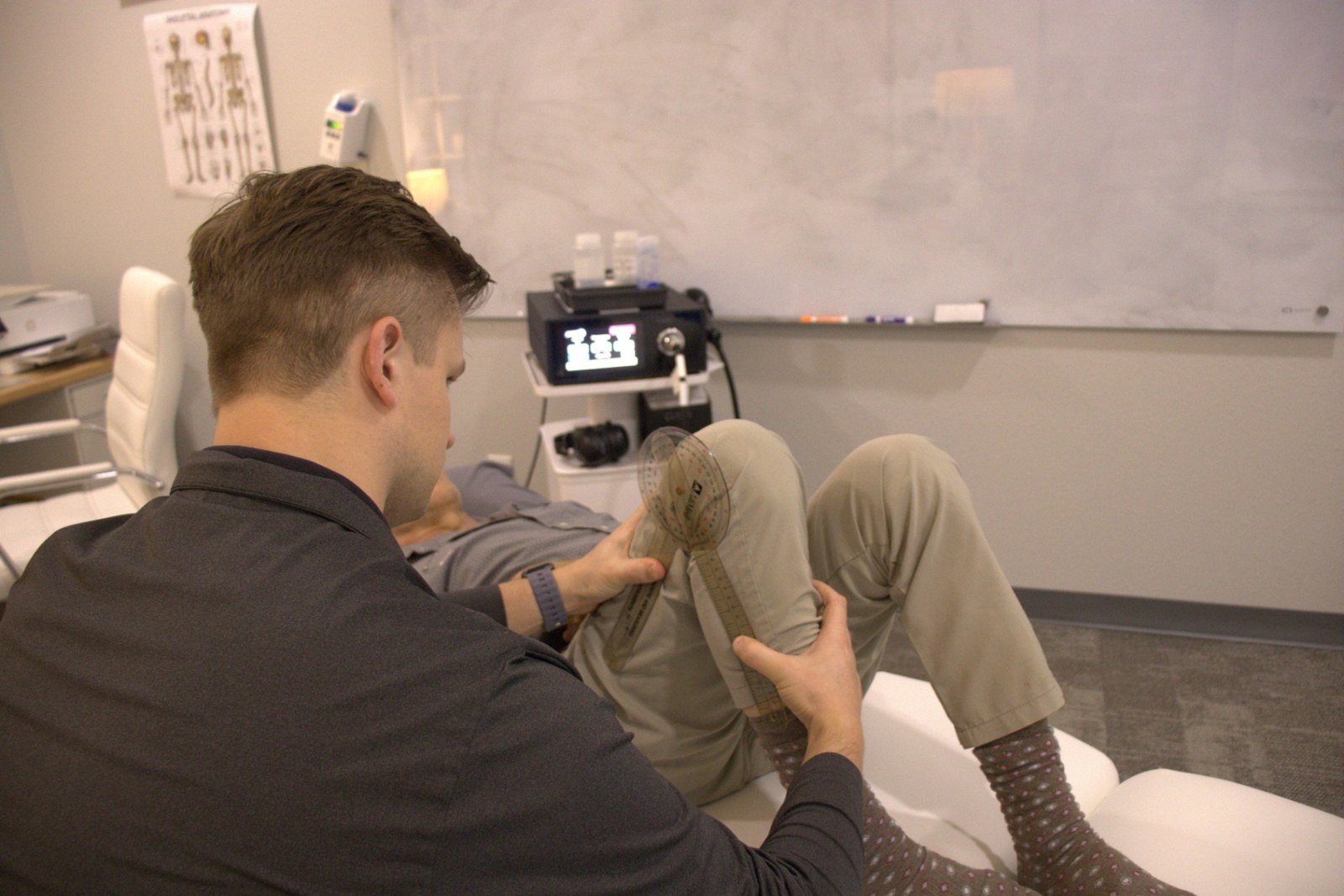
Every patient starts with an Omniwave Strategy Session, a clinical evaluation with a licensed physical therapist. This isn't a formality before treatment- it creates the treatment plan.
We look at where the pain actually is and what reliably brings it on. We test how much load your knee tolerates right now. We check strength and control at the hips, thighs, and calves on both sides. We watch you squat, step, and walk, and we see whether changing how you move changes the pain. We ask what you've tried and how it’s progressed.
Knee pain is a descriptor, not a diagnosis. Pain around the kneecap, pain in the surrounding muscles, and pain deep in a joint behave differently and respond to different plans. Shockwave helps some of these more than others, and the assessment tells us which situation you're in before we decide if shockwave belongs in your plan.
Step 2: Neuromuscular PT retrains the system
Neuromuscular physical therapy means we're not just strengthening muscles- we're retraining how they fire and how well they control the knee while you move.
Weak or poorly timed hip muscles let the knee drift into positions that overload the tendon or the joint. Retraining that control, then building strength on top of it, is how we change the load your knee sees on every step and every stair. This is why hip and knee work together is the standard recommendation (Collins et al., 2018), and why exercise is a first-line treatment for knee osteoarthritis, with pain relief comparable to common pain medications (Fransen et al., 2015).
The loading itself is progressive. We start where your knee can tolerate and build in stages, the way the Breda et al. (2021) program did, rather than pushing through pain and hoping.
Step 3: Shockwave targets the tissue
Shockwave delivers acoustic (sound-wave) energy into the irritated tissue. It makes a difference in two ways that matter for a stuck knee.
It initiates a healing response. Shockwave at lower energy settings may accelerate the body’s healing process and support tissue regeneration (Chen et al., 2022). The proposed mechanism is mechanotransduction: cells convert the mechanical stimulus into a biochemical signal, releasing growth factors and promoting new blood vessel growth in tissue that has been stagnant. For a tendon that has stopped adapting on its own, this is a nudge to start again.
It modulates pain. Shockwave appears to reduce pain through several routes, including hyperstimulation of the painful area, which dampens the pain signal reaching the brain, and effects on the small nerve fibers involved in pain (Chen et al., 2022). Less pain is not the goal in itself. A knee that hurts less can be loaded more, and loading is what actually builds capacity.
Why the pairing matters: Shockwave on its own asks nothing of the knee, so it doesn't build strength or control. Exercise on its own sometimes can't get a long-stuck tendon to respond. Together, shockwave can prime the tissue and open a pain window, and the neuromuscular program fills that window with the loading the knee needs. A review of combined shockwave and exercise found the pairing produced positive results across tendinopathies (Burton, 2022).
Step 4: Progress the load, taper the shockwave
Shockwave is a short course, typically a handful of sessions. The loading program continues well beyond it, because the strength and control you build is what keeps the knee working after treatment ends. We adjust the plan as your knee responds. Your physical therapist decides when to add load, when to hold, and when shockwave has done its job.
What the research says about shockwave for the knee specifically
Knee osteoarthritis. A meta-analysis of 14 randomized trials found moderate-quality evidence that shockwave reduces pain and improves function in the short term, with few minor side effects (Avendaño-Coy et al., 2020). The benefit depends on the energy setting used, which is why the settings are a clinical decision made by your physical therapist, not a preset.
There's a tissue-level reason for that result. In animal models of knee osteoarthritis, shockwave slowed cartilage breakdown, calmed inflammation, improved the bone under the cartilage, and lowered pain-signaling activity in the nerves that serve the joint (An et al., 2020). That's animal data, not proof of cartilage regrowth in people. But it means shockwave isn't just a numbing agent. It acts on the tissue, which is why we pair it with loading that gives the tissue something to adapt to.
Patellar tendinopathy. Here the evidence is mixed. Trials in athletes found no reliable long-term benefit over other conservative care, and the researchers flagged a reason: shockwave adds a stimulus to the tendon, and stacking it on heavy sport or very intensive eccentric exercise can overload the tissue instead of helping it (Stania et al., 2022). That's the case for our model. Shockwave works when the load around it is managed, and managing load is what a physical therapist does.
What shockwave won't do
It won't fix a knee that's being asked for too much, too fast. It won't replace strength or movement control. It won't help every knee, and if your assessment points to a problem shockwave doesn't address, we'll say so and build the plan without it.
The physical therapist decides the plan. Not a protocol, and not the device.
The bottom line
Persistent knee pain means there's a gap between what your knee is asked to do and what it can handle. Rest doesn't close it. Generic exercises often miss the dose, the type, or the driver. At Agudo Shockwave, a physical therapist finds the driver, neuromuscular PT retrains and reloads the system, and shockwave, for the right knee, helps stuck tissue respond so the loading can do its work. The plan comes first- shockwave complements the plan.
Want to learn more?
Not sure where to start? Schedule a Discovery Call with Agudo Shockwave to ask questions and understand your options.
Ready for a clinical evaluation? Book an Omniwave Strategy Session with one of our licensed physical therapists to find out what's driving your knee pain and whether shockwave fits your plan.
References
- An, S., Li, J., Xie, W., Yin, N., Li, Y., & Hu, Y. (2020). Extracorporeal shockwave treatment in knee osteoarthritis: Therapeutic effects and possible mechanism. Bioscience Reports, 40, BSR20200926. https://doi.org/10.1042/BSR20200926
- Avendaño-Coy, J., Comino-Suárez, N., Grande-Muñoz, J., Avendaño-López, C., & Gómez-Soriano, J. (2020). Extracorporeal shockwave therapy improves pain and function in subjects with knee osteoarthritis: A systematic review and meta-analysis of randomized clinical trials. International Journal of Surgery, 82, 64–75. https://doi.org/10.1016/j.ijsu.2020.07.055
- Breda, S. J., Oei, E. H. G., Zwerver, J., Visser, E., Waarsing, E., Krestin, G. P., & de Vos, R.-J. (2021). Effectiveness of progressive tendon-loading exercise therapy in patients with patellar tendinopathy: A randomised clinical trial. British Journal of Sports Medicine, 55(9), 501–509. https://doi.org/10.1136/bjsports-2020-103403
- Burton, I. (2022). Combined extracorporeal shockwave therapy and exercise for the treatment of tendinopathy: A narrative review. Sports Medicine and Health Science, 4(1), 8–17. https://doi.org/10.1016/j.smhs.2021.11.002
- Chen, Y., Lyu, K., Lu, J., Jiang, L., Zhu, B., Liu, X., Li, Y., Liu, X., Long, L., Wang, X., Xu, H., Wang, D., & Li, S. (2022). Biological response of extracorporeal shock wave therapy to tendinopathy in vivo (review). Frontiers in Veterinary Science, 9, 851894. https://doi.org/10.3389/fvets.2022.851894
- Collins, N. J., Barton, C. J., van Middelkoop, M., Callaghan, M. J., Rathleff, M. S., Vicenzino, B. T., Davis, I. S., Powers, C. M., Macri, E. M., Hart, H. F., de Oliveira Silva, D., & Crossley, K. M. (2018). 2018 Consensus statement on exercise therapy and physical interventions (orthoses, taping and manual therapy) to treat patellofemoral pain: Recommendations from the 5th International Patellofemoral Pain Research Retreat, Gold Coast, Australia, 2017. British Journal of Sports Medicine, 52(18), 1170–1178. https://doi.org/10.1136/bjsports-2018-099397
- Cook, J. L., & Purdam, C. R. (2009). Is tendon pathology a continuum? A pathology model to explain the clinical presentation of load-induced tendinopathy. British Journal of Sports Medicine, 43(6), 409–416. https://doi.org/10.1136/bjsm.2008.051193
- Fransen, M., McConnell, S., Harmer, A. R., Van der Esch, M., Simic, M., & Bennell, K. L. (2015). Exercise for osteoarthritis of the knee. Cochrane Database of Systematic Reviews, 2015(1), CD004376. https://doi.org/10.1002/14651858.CD004376.pub3
- Stania, M., Król, T., Marszałek, W., Michalska, J., & Król, P. (2022). Treatment of jumper's knee with extracorporeal shockwave therapy: A systematic review and meta-analysis. Journal of Human Kinetics, 84, 124–134. https://doi.org/10.2478/hukin-2022-0089