Explaining Shockwave Therapy
What a shockwave is, how it became a treatment, what it does, and what it feels like.
Written by the Agudo Shockwave Team · Clinically reviewed by Evan Cowen, PT, DPT · October 2, 2026
If you've heard of shockwave therapy but aren't sure what it actually is, you're not alone. Many of the active adults we talk to have seen the term online or heard it from a friend or another provider, but still have questions. This post walks through what a shockwave is, how it became a medical treatment, what it does, what it feels like, and what separates one type of device from another.
What is a shockwave?
Start with sound- sound is pressure moving through a medium. When something vibrates, it pushes on the air, water, or material around it, and that push travels outward as a wave of alternating high and low pressure. An ordinary sound wave moves at the speed of sound, and its pressure rises and falls smoothly, like a ripple.
A shockwave is a sound wave that has been pushed past that limit. When a disturbance is powerful enough, pressure builds faster than the medium can carry it away, and the wave breaks the sound barrier. Its shape changes too: instead of a smooth rise, pressure jumps almost instantly to a sharp peak, then falls off and briefly dips below normal before returning to baseline. Thunder is a shockwave, created when lightning heats the air so fast it expands faster than sound can travel. A sonic boom is a shockwave, created by a jet outrunning its own sound.
In short, a shockwave is a supersonic sound wave. It belongs to the same family of energy as ordinary sound, delivered as a single, abrupt pulse rather than a continuous tone. It has nothing to do with electricity.
From kidney stones to tendons: how a shockwave became a therapy
Shockwave therapy did not start in sports medicine. Its roots are in urology. In the early 1980s, physicians began aiming focused shockwaves at kidney stones from outside the body to break them apart without surgery, a procedure called lithotripsy. It worked, and it changed how kidney stones are treated.
Along the way, clinicians noticed something else: the shockwaves also seemed to influence the surrounding tissue, including bone. That observation led researchers to ask what would happen if the same energy were turned down dramatically and applied to musculoskeletal problems. At a fraction of the intensity used to shatter a stone, shockwaves no longer break anything. Instead, they appear to stimulate tissue. That is the therapy used today, and it is why you'll often see it called low-intensity extracorporeal shockwave therapy. "Extracorporeal" simply means the energy is delivered from outside the body, with no needles or incisions.
Early research focused on slow-healing fractures, then expanded to chronic tendon and soft tissue pain. In the U.S., devices were cleared for chronic plantar fasciitis in 2000 and for tennis elbow in 2002 (Wang, 2012). Today the treatment is used in physical therapy, orthopedic, and sports medicine settings worldwide, and the research base keeps growing.
What does shockwave therapy do in the body?
When a low-intensity shockwave passes through a painful area, the mechanical energy is thought to help in a few ways:
Stimulating tissue repair. The pulse acts as a mechanical signal that cells respond to, which appears to trigger the biological processes involved in healing and remodeling. This is especially relevant in stubborn tendon problems that haven't responded to rest or time.
Supporting blood flow. Some research suggests shockwave promotes the formation of new small blood vessels in treated tissue.
Modulating pain. Shockwave may change how pain signals are processed, which can open a window where people move more comfortably.
This process is often called mechanotransduction: mechanical stimulation that produces a biological response, including the release of growth factors, new blood vessel formation, and anti-inflammatory effects (Moya et al., 2018). Researchers are still working out exactly how and why shockwave works, and the mechanisms likely differ by condition.
What conditions is it used for?
In musculoskeletal care, shockwave therapy has been studied most for persistent soft tissue and tendon problems, including plantar fasciitis (heel pain), Achilles tendinopathy, rotator cuff-related shoulder pain, tennis elbow, patellar (knee) tendinopathy, and hip or gluteal tendon pain. Systematic reviews have found supportive evidence for several of these conditions, while noting that protocols, devices, energy levels, and results vary from study to study (Schmitz et al., 2015; Speed, 2014).
These are typically the "stubborn" problems: the ones that linger for months despite rest, stretching, or basic rehab. That is where shockwave is usually considered.
What does it feel like?
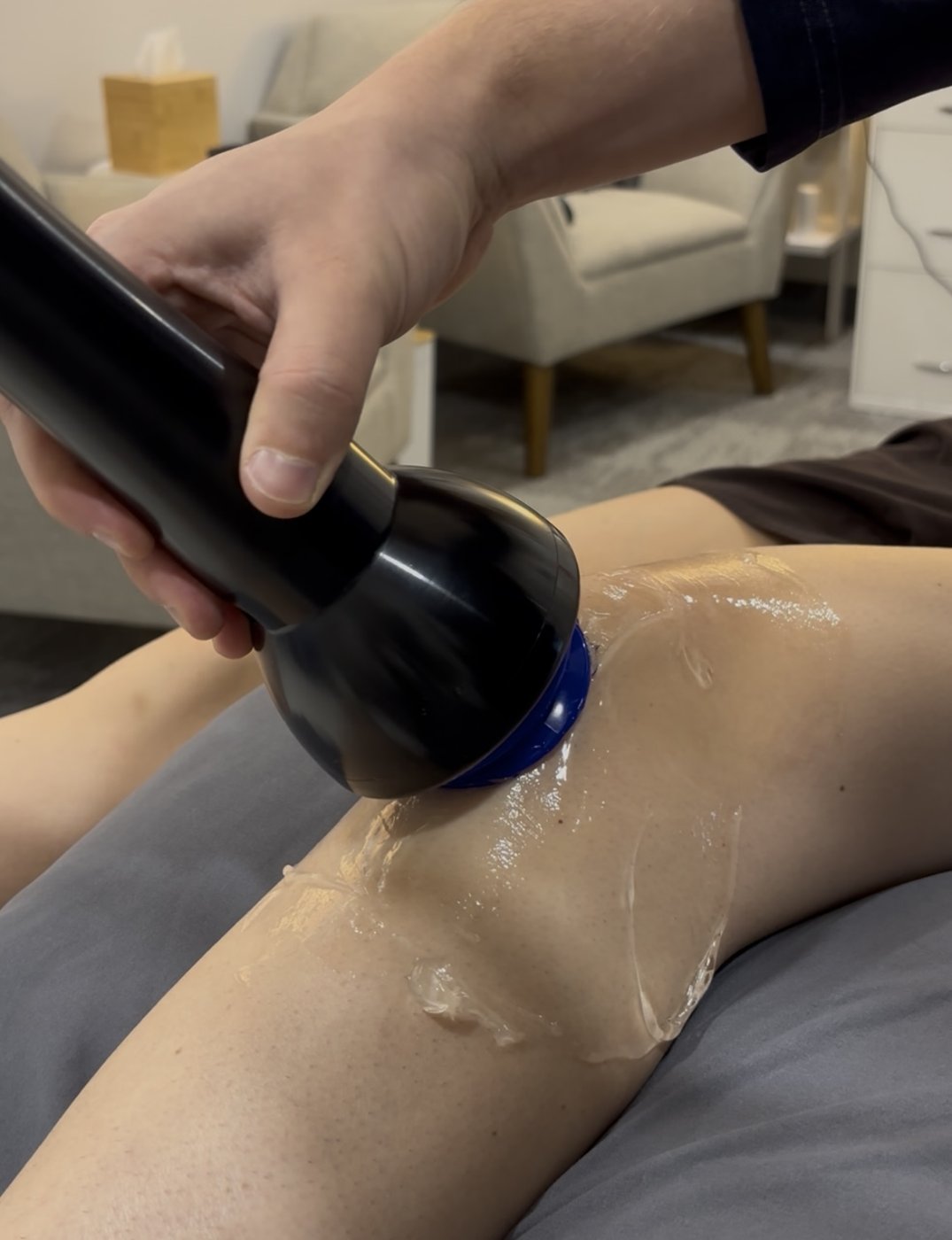
Most people describe a rhythmic tapping or pulsing pressure that ranges from mild to intense, especially over tissue that is already irritated. The sensation depends on the device, the area being treated, and the intensity setting. Intensity is adjustable, and we set it to what is appropriate and tolerable for you. Sessions are short, no anesthesia is needed, and you can typically go about your day afterward. Some people notice temporary redness or mild soreness in the treated area, which usually settles quickly.
How our patients describe it
When we ask people at Agudo Shockwave to put the sensation into words, a few themes come up again and again. Most say the pulses are easy to tolerate over healthy tissue and become noticeable only when the applicator reaches the problem spot. As one patient put it, "It doesn't feel like anything until it hits the damaged spot. Then it kind of feels like pressure on a bruise." Others describe a dull ache over the general area with occasional sharper, pinch-like points, or say the individual pulses range from barely perceptible to a slight, temporary aching. Several have described it as an amplified version of the discomfort they already feel day to day, "but in a healing manner." The short version we hear most often: "a good kind of hurt," "mildly sore, but better after," and a treated area that feels "loose and mobile" once the session is over.
Shockwave is a tool, not the whole plan
This is one of our strongest opinions: the device matters, but it should be paired with proper movement.
Shockwave is not magic, and it is not a "one and done" fix. Most stubborn pain conditions are shaped by strength, mobility, training habits, workload, recovery, sleep, previous injuries, and how confidently someone moves. Tendons in particular rarely improve just because someone rests indefinitely. They need the right balance of load, strength, recovery, and progression.
The research supports this. In a randomized controlled trial of people with chronic midportion Achilles tendinopathy, those who received shockwave combined with an eccentric loading program reported significantly better pain and function at four months than those who did eccentric loading alone (Rompe et al., 2009). Notably, in a 2025 meta-analysis of 28 trials, most studies delivered shockwave alongside exercise or other conventional treatment rather than on its own (Ismail Hassan et al., 2025), which reflects how it is used in practice.
That's why, when someone comes to us with Achilles pain, the question isn't just "where does it hurt?" It's also: How long has this been going on? What makes it worse? What are you trying to return to? Is your current training load too much, too soon? What can we modify without stopping everything?
At Agudo Shockwave, Omniwave is one part of a care model that includes physical therapy-informed movement assessment, skilled manual treatment when appropriate, education about pain and recovery, and a plan built around your goals. The goal isn't just to treat the painful spot. It's to help you understand your problem and resolve what's driving it.
Who might be a fit?
Shockwave therapy may be worth exploring if you're dealing with pain in your heel, Achilles, shoulder, elbow, knee, hip, or other areas that haven’t responded to rest, basic stretching, or time. Not every person is a good fit, and not every condition should be treated with shockwave. Screening, medical history, and the location and type of symptoms all matter. That's why we start with a conversation and a plan, not just a machine.
The bottom line
Shockwave therapy is a well-studied, non-invasive option for certain stubborn musculoskeletal conditions. It delivers acoustic energy into tissue to stimulate the body's natural healing process, and it works best when matched to the right problem and paired with a smart movement plan.
If you're still deciding whether this approach makes sense for you, a Discovery Call is a good first step. It's a chance to learn more about how we work, ask questions, and get a clearer picture of your options with no commitment. If you're ready to find out whether focused shockwave is appropriate for your specific problem, book an Omniwave Strategy Session with one of our licensed physical therapists for a clinical evaluation and a plan built around your goals.
References
- Ismail Hassan, M., Shafiek Mustafa Saleh, M., Hesham Sallam, M., Hesham Elkhodary, H., Mohamed Sayed, M., Samy, H., Hesham Mohamed, A., Said Ashour, A., Mohamed Mosaid, E., Hassan Zaghloul, M., Ramadan Elbathesh, E., Vaish, H., Alshehri, M. A. A., & Ibrahim Abdelhamed, A. (2025). Extracorporeal Shock Wave Therapy versus laser therapy in treating musculoskeletal disorders: A systematic review and meta-analysis. Lasers in Medical Science, 40, Article 194. https://doi.org/10.1007/s10103-025-04392-0
- Moya, D., Ramón, S., Schaden, W., Wang, C.-J., Guiloff, L., & Cheng, J.-H. (2018). The role of extracorporeal shockwave treatment in musculoskeletal disorders. The Journal of Bone and Joint Surgery. American Volume, 100(3), 251–263. https://doi.org/10.2106/JBJS.17.00661
- Rompe, J. D., Furia, J., & Maffulli, N. (2009). Eccentric loading versus eccentric loading plus shock-wave treatment for midportion Achilles tendinopathy: A randomized controlled trial. The American Journal of Sports Medicine, 37(3), 463–470. https://doi.org/10.1177/0363546508326983
- Schmitz, C., Császár, N. B. M., Milz, S., Schieker, M., Maffulli, N., Rompe, J.-D., & Furia, J. P. (2015). Efficacy and safety of extracorporeal shock wave therapy for orthopedic conditions: A systematic review on studies listed in the PEDro database. British Medical Bulletin, 116(1), 115–138. https://doi.org/10.1093/bmb/ldv047
- Speed, C. (2014). A systematic review of shockwave therapies in soft tissue conditions: Focusing on the evidence. British Journal of Sports Medicine, 48(21), 1538–1542. https://doi.org/10.1136/bjsports-2012-091961
- Wang, C.-J. (2012). Extracorporeal shockwave therapy in musculoskeletal disorders. Journal of Orthopaedic Surgery and Research, 7, Article 11. https://doi.org/10.1186/1749-799X-7-11